

Introduction
Tonsillectomy is one of the most commonly performed otolaryngologic surgeries worldwide, primarily indicated for recurrent tonsillitis, obstructive sleep apnea, and tonsillar hypertrophy.1) Despite its clinical effectiveness, postoperative pain remains one of the most significant drawbacks of the procedure, often leading to decreased oral intake, sleep disturbance, and reduced quality of life.2,3) Effective pain control is therefore essential to optimizing postoperative recovery and preventing secondary complications.
To establish appropriate pain-management strategies, numerous studies have investigated postoperative pain following tonsillectomy.4,5) However, many prior studies relied on self-reported pain diaries after discharge or involved intermittent assessment rather than daily, continuous evaluation. In Korea, the diagnosis-related group (DRG) payment system commonly results in discharge on postoperative day (POD) 1–2, which further limits the feasibility of collecting detailed daily pain trajectories over an extended postoperative period. Consequently, there is a lack of long-term, daily inpatient pain data that would allow a clear understanding of postoperative pain progression and inform evidence-based pain-management protocols.
In this context, we conducted the present study within a military hospital setting, where extended postoperative hospitalization is routinely feasible. This unique system enabled daily assessment of pain. The aim of this study was to characterize the day-to-day postoperative pain trajectory after coblation tonsillectomy and to provide practical recommendations for pain management and outpatient follow-up applicable to the Korean medical environment.
Materials and Methods
Patients who underwent coblation tonsillectomy with a history of recurrent tonsillitis between November 1, 2024, and October 31, 2025, were retrospectively reviewed. Patients who were hospitalized for at least 13 postoperative days were included. Patients with acute inflammation, congenital anomalies, coagulation disorders, a history of taking anticoagulants, neoplasms, or those who underwent concomitant adenoidectomy were excluded.
All surgeries were performed under general anesthesia using a coblation device (ArthroCare ENT Coblator II, ArthroCare, Sunnyvale, CA, USA) with standard settings of 7 W for coblation and 5 W for coagulation. Four surgeons with sufficient surgical experience performed the procedures.
Pain control during hospitalization was managed with oral analgesics. Ultracet (acetaminophen 325 mg with tramadol 37.5 mg; Janssen, Seoul, Korea) was administered three times daily for the first 7 postoperative days, followed by Tacenol (acetaminophen 650 mg, Bukwang, Seoul, Korea) three times daily until discharge.
Postoperative pain was assessed using the visual analog scale (VAS), where 0 indicated no pain and 10 indicated the most severe pain. On POD 0, pain was recorded after full recovery from general anesthesia, whereas on POD 1 and thereafter, pain was assessed every morning immediately after waking. All patients were instructed preoperatively that a VAS score ≥4 represented moderate or greater pain, for which additional analgesics might be required.
Postoperative clinical outcomes included daily morning VAS pain scores, and postoperative hemorrhage. Hemorrhage was defined as any bleeding event requiring medical or surgical intervention. This study was approved by the Institutional Review Board (IRB file No. 2025-11-004).
Continuous variables were summarized as mean±SD. Daily postoperative VAS scores were analyzed using repeated-measures analysis of variance (ANOVA) with Bonferroni correction to evaluate changes in pain over time. A p-value<0.05 was considered statistically significant. All statistical analyses and visualization were conducted using the R software (version 4.3.1, R Foundation for Statistical Computing, Vienna, Austria).
Results
Table 1 summarizes the demographic characteristics of the study population. A total of 111 patients (111 males, 0 females) with a mean age of 22.48 years (SD, 5.04 years) were included. Size of tonsil was classified as Friedman grade I in 7 patients (6.31%), grade II in 42 (37.84%), grade III in 51 (45.94%), and grade IV in 11 (9.91%). The mean postoperative duration of hospitalization was 15.20 days (SD, 3.03 days).
Daily postoperative VAS scores are presented in Fig. 1. The mean VAS score increased slightly from 2.11 (SD, 1.31) on POD 0 to 2.21 (SD, 1.21) on POD 2. Thereafter, pain scores gradually decreased each day, reaching 0.98 (SD, 1.41) by POD 13. Notably, even across the transition from tramadol with acetaminophen to acetaminophen alone on POD 7 to POD 8, the VAS score continued to decrease from 1.42 (SD, 1.04) to 1.30 (SD, 1.11).
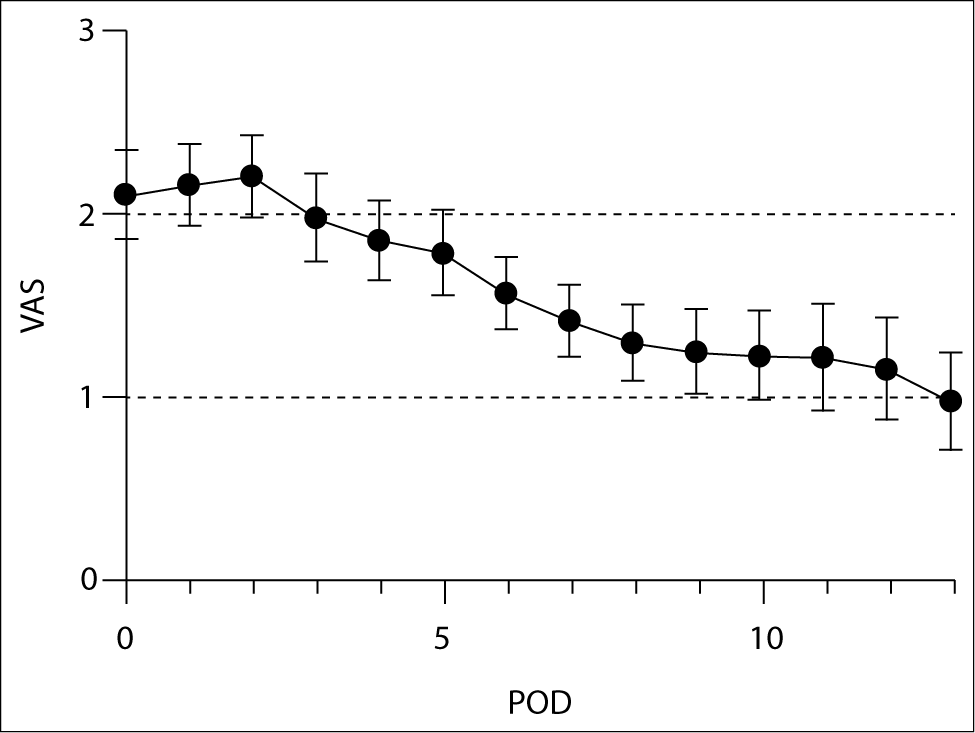
Post-hoc pairwise comparisons with Bonferroni correction revealed that although pain scores increased from POD 0 to POD 2 (mean difference, –0.099), this change was not statistically significant (p=1.00). Statistically significant differences compared with POD 0 first appeared on POD 6 (p=0.008), with a mean difference of 0.541. While POD 6 (VAS 1.57, SD 1.05) did not differ significantly from POD 12 (VAS 1.16, SD 1.48; p=0.30), it showed a significant difference compared with POD 13, when the mean VAS score first fell below 1.0 (mean 0.98, SD 1.41; p=0.002).
The change in analgesic regimen from tramadol with acetaminophen to acetaminophen alone (POD 7 vs. POD 8) did not result in a statistically significant difference in pain scores (mean difference, 0.126; p=1.00). By contrast, POD 0 and POD 13 demonstrated a significant overall reduction in pain, with a mean difference of 1.126 (p<0.001).
Table 2 lists patients who experienced postoperative hemorrhage requiring intervention. Four patients required medical or surgical management.
Patient 1 developed diffuse bleeding from the right tonsillectomy bed immediately after surgery; bleeding ceased following local injection of lidocaine with epinephrine (20 and 0.01 mg, respectively) without the need for cauterization.
Patient 2 experienced bleeding from the right inferior pole on POD 8 and underwent bipolar cauterization under general anesthesia.
Patients 3 and 4 developed bleeding on POD 13, respectively. Both had bleeding from the inferior pole (right and left sides, respectively) and underwent bipolar cauterization in a seated position following local lidocaine with epinephrine injection. No patients experienced recurrent bleeding or required additional intervention after discharge.
Discussion
Post-tonsillectomy pain remains the most significant obstacle to postoperative recovery despite advances in surgical techniques and perioperative management. The pain is primarily induced by pharyngeal mucosal injury, exposure of pharyngeal musculature, inflammatory mediator release, and subsequent nociceptor sensitization following surgical tissue damage.6) While opioid-based analgesics are effective for early postoperative pain, their adverse effects such as sedation, nausea, and dependence limit prolonged use. Conversely, acetaminophen has a more favorable safety profile but provides weaker analgesic potency.7,8) Therefore, defining the optimal duration for opioid-containing analgesics while minimizing unnecessary exposure remains an important clinical issue. This clinical need aligns closely with international pain-management guidelines, such as the procedure-specific postoperative pain management (PROSPECT) recommendations for adult tonsillectomy, which fundamentally emphasize an “opioid-sparing strategy” and advocate for minimizing routine opioid use.9)
In the present study, postoperative pain after coblation tonsillectomy showed a consistent and predictable temporal pattern. Pain increased slightly until POD 2, although not reaching statistical significance, and then gradually declined thereafter. This early peak corresponds well with the acute inflammatory phase of wound healing, which typically dominates the first 48 hours after mucosal injury. During this phase, fibrin deposition, local edema, and inflammatory cell infiltration are maximal, contributing to heightened tissue sensitivity.10,11) From POD 3 onward, pain steadily decreased as re-epithelialization, with the first statistically significant reduction relative to POD 0 observed on POD 6.
One of the most clinically relevant findings of this study is that the transition from tramadol with acetaminophen to acetaminophen alone at POD 8 did not result in any deterioration of pain control. The absence of a pain rebound after opioid discontinuation strongly suggests that routine continuation of opioid-containing analgesics beyond the first postoperative week may be unnecessary in otherwise healthy young adults undergoing coblation tonsillectomy. Given the known risks associated with tramadol, our findings support a strategy of early opioid withdrawal and step-down to acetaminophen alone beginning around POD 5. However, future prospective randomized controlled trials comparing early non-opioid step-down against conventional regimens should be necessary.
Importantly, although the mean VAS scores in this cohort were lower than those reported in prior studies (typically ranging from 4.4 to 6.0),12–14) this difference does not necessarily indicate less severe nociception. All patients were preoperatively instructed that a VAS score ≥4 represented moderate or greater pain requiring rescue analgesics. This standardized calibration likely reduced inter-individual variability in pain reporting and improved the internal consistency of the longitudinal pain trajectory. Furthermore, pain was assessed every morning immediately upon waking while patients were at rest, which theoretically minimized the pain spikes triggered by daily physical activities or eating.
Post-tonsillectomy hemorrhage remains a potentially life-threatening complication and is classically categorized as either primary (within 24 hours) or secondary (after 24 hours) bleeding15,16). One patient developed primary hemorrhage immediately after surgery, which was controlled with local vasoconstrictor injection. Three patients developed secondary hemorrhage on POD 8 and POD 13, all originating from the inferior pole of the tonsillar fossa. Notably, two of these secondary hemorrhages occurred on POD 13, when the mean pain score had already fallen below a VAS of 1.0. Subjective pain relief does not necessarily imply complete mucosal healing, and patients remain at risk for delayed hemorrhage even when discomfort has largely resolved.
Previous studies have reported overall post-tonsillectomy hemorrhage rates of approximately 4.5%, with primary and secondary hemorrhage ranging from 0.2%–2.2% and 0.1%–3.5%, respectively.4,17,18) In comparison, the overall hemorrhage rate in our study was 3.6%, consisting of 0.9% primary and 2.7% secondary bleeding, which is within or below the ranges reported in the literature.
The present study has several notable strengths. First, the cohort consisted exclusively of young, medically healthy adults, minimizing confounding effects from age- or disease-related pain modulation. Second, the unique military hospital environment allowed uninterrupted daily inpatient pain assessment for more than 13 postoperative days, enabling a detailed and continuous depiction of the natural pain course after coblation tonsillectomy—data that are rarely obtainable in civilian practice. Third, the surgical technique and postoperative analgesic protocol were strictly standardized, further enhancing internal validity.
However, several limitations should be noted. First, patients discharged before POD 13 were excluded. Although the number of early discharges was small due to the nature of the military hospital system, where most patients remain hospitalized for more than 13 days, the exclusion may contribute to selection bias. Nonetheless, because pain is inherently subjective, including early discharged individuals with incomplete pain curves may have distorted the analysis. Second, the study population consisted exclusively of young male soldiers, limiting generalizability to females, older adults, and individuals with medical comorbidities. Third, due to its retrospective nature, several critical confounding variables—such as the intraoperative severity of tonsillar adhesion, individual smoking history, and prior history of recurrent infections—could not be systematically controlled or analyzed, which may have influenced both pain perception and wound recovery.
Conclusion
In conclusion, in this specific cohort postoperative pain after coblation tonsillectomy demonstrates a mild early peak around POD 2, followed by a gradual and sustained decline, with significant improvement beginning at POD 6. The transition from tramadol with acetaminophen to acetaminophen alone at POD 8 did not compromise pain control, supporting early opioid step-down strategies. Despite substantial pain reduction by POD 13, delayed secondary hemorrhage may still occur, emphasizing the need for continued patient education and outpatient vigilance through this period. These findings provide a practical framework for optimizing postoperative analgesic protocols and follow-up schedules after coblation tonsillectomy.


